
- All
- Product Name
- Product Keyword
- Product Model
- Product Summary
- Product Description
- Multi Field Search
Views: 0 Author: Site Editor Publish Time: 2026-09-16 Origin: Site


Picture this: a heavy-duty rig is sidelined on the highway. The driveshaft is detached, the load is delayed, and the delivery schedule is completely ruined. Unexpected driveline failures do more than just generate massive vehicle repair bills. They paralyze commercial operations. Often, the silent culprit behind this mechanical chaos is a severely degraded transmission component.
Catching this degradation early is the absolute easiest way to prevent severe, cascading damage to the driveshaft, universal joints, and differential. In this comprehensive guide, you will learn the exact, mechanic-approved steps to diagnose, inspect, and replace a worn ZF output flange before it triggers a catastrophic roadside breakdown.
Early Detection Saves Money: Spotting wear on your transmission's rear connection point prevents expensive collateral damage to the driveshaft and internal gearbox bearings.
Vibration is a Red Flag: Unexplained harmonic shaking under the floorboards is frequently the first physical symptom of a failing connection.
Physical Play Indicates Failure: Any radial (up-and-down) or axial (in-and-out) movement means immediate component replacement is non-negotiable.
Quality Replacements Matter: Sourcing premium replacement components ensures longevity, proper alignment, and safe torque transfer for heavy-duty applications.
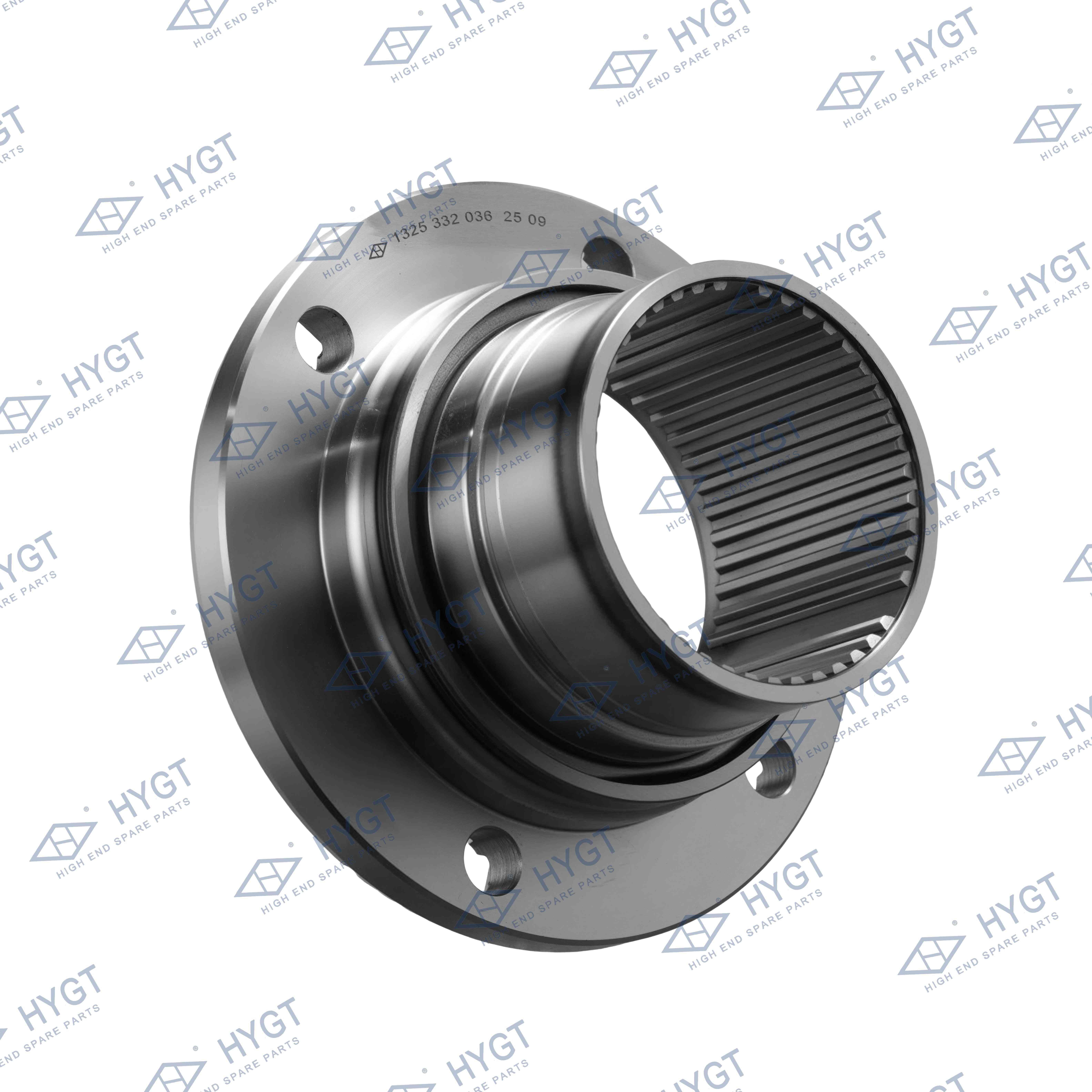
Located at the very rear of the transmission tail housing, this heavy-duty mechanical component acts as the vital bridge between the gearbox and the rest of the vehicle. Its primary function is to serve as the secure connection point between the transmission's main output shaft and the driveshaft yoke. Engines generate the power. Transmissions multiply it. But the flange actually delivers that kinetic energy to the pavement.
Without it, rotational torque cannot reach the wheels. It bears the full, violent brunt of a vehicle's acceleration, hard braking, and heavy payload forces. Because it handles high-stress loads continuously, maintaining its structural integrity is a baseline requirement for fleet safety.
Modern gearboxes are engineered to exacting, microscopic tolerances. They are designed for maximum efficiency in severe-duty environments. Specifically, these systems rely on absolute rotational balance. Even a single millimeter of uneven wear can disrupt the delicate equilibrium of the entire driveline system. When this part loses its precise machined dimensions, it introduces a slight wobble into the driveshaft's rotation. This eccentric movement creates parasitic harmonic waves that travel backward into the fragile transmission housing and forward into the rear axle.
One of the most reliable indicators of a degrading connection is noticeable shaking. Under ideal conditions, a healthy hub keeps the driveshaft perfectly centered. However, as the internal splines or the mounting face begin to wear down, the driveshaft shifts out of its optimal rotational axis.
This imbalance creates a severe shudder that typically originates directly underneath the driver's seat. Unlike an unbalanced tire, which often vibrates only at specific highway speeds, transmission flange wear usually worsens progressively the harder you press the accelerator. Fleet operators must document any sudden changes in ride smoothness. Ignoring this symptom allows the eccentric rotation to literally tear apart surrounding steel components.
Another major red flag is fluid loss. The smooth outer diameter of the hub serves as the riding surface for the rubber output shaft seal. Over thousands of miles of driving through rain, grit, and road salt, normal friction causes this metal surface to develop deep grooves. Once a groove is carved into the steel, the rubber seal can no longer maintain a tight, fluid-proof barrier. You might notice a puddle of red fluid under the tail housing after the truck has been parked overnight. Low fluid levels subsequently lead to poor internal lubrication, increased friction, and dangerously elevated operating temperatures.
Furthermore, listen for clunking noises during shifting. A harsh, metallic "clunk" heard when shifting a vehicle from Park to Drive, or from Drive to Reverse, is a massive diagnostic clue. This noise is frequently caused by excessive backlash—or free play—between the internal splines of the flange and the external splines of the gearbox shaft. When these splines are brand new, they mesh together tightly with zero rotational slop. As the metal wears down from years of torque reversals, a small gap forms. When you put the truck in gear, the shaft rotates slightly before violently slamming into the worn splines.
In the heavy-duty commercial sector, fleet management is rapidly evolving from reactive repairs to predictive maintenance. Modern diagnostic trends show a heavy reliance on telematics and advanced vibration analysis. Today, sophisticated chassis sensors can detect micro-harmonic imbalances long before a driver ever feels the steering wheel shake.
Despite these digital advancements, physical component degradation remains a pressing, mechanical reality. With global logistics demanding higher payload capacities and continuous routing, drivetrain components are being pushed to their absolute metallurgical limits. Industry experts emphasize a hybrid approach. While software can predict a failure timeline based on vibration data, traditional, hands-on mechanical inspections of the connection points are more critical than ever. Telematics will tell you a vibration exists; getting under the truck tells you exactly which spline is failing.
Commercial trucks operate under brutal conditions. Towing heavy trailers, hauling maximum payload capacities up steep grades, and navigating constant stop-and-go city traffic put immense mechanical stress on the entire drivetrain. Every time a fully loaded rig accelerates from a dead stop, the rear connection point must absorb a massive, instantaneous spike in torque.
Over time, this constant application of heavy force leads to unavoidable metal fatigue. Even forged steel components have a finite lifespan when subjected to continuous maximum load ratings. Eventually, this leads to micro-fractures or spline deformation.
In addition, driveshaft misalignment accelerates wear exponentially. The driveshaft is designed to operate within very specific working angles. If a vehicle's suspension sags, is altered, or if a center support bearing fails, the driveshaft becomes misaligned. This exerts uneven lateral pressure—known as side-loading—on the flange. Instead of the rotational force being distributed evenly across the machined face, the pressure focuses entirely on one edge.
Finally, a lack of lubrication and maintenance will destroy the surrounding mechanical ecosystem. The slip yoke and universal joints (U-joints) attached to it must be greased regularly. If these components dry out and seize up, they lose their ability to articulate smoothly over bumps. A bound U-joint forces the entire driveline rigid, transferring harsh road shocks directly into the transmission casing.
Before sliding under any heavy vehicle, strict safety protocols must be followed. Park the rig on a dead-flat concrete slab. Engage the parking brake firmly and place heavy-duty wheel chocks behind and in front of the tires. Do not risk an 80,000-pound vehicle rolling while you are wrenching underneath. If the vehicle needs to be raised, use correctly rated hydraulic jacks and secure the chassis on heavy-duty jack stands. Shift the transmission into neutral so the driveshaft can be rotated freely by hand.
Begin with a thorough visual examination using a bright LED flashlight. Look closely at the bottom of the tail housing for fresh oil droplets or heavy, dirt-caked grease buildup. This indicates a failing seal. Next, check the mating surface between the flange and the driveshaft yoke. If you see a fine, reddish-brown dust, you are looking at fretting corrosion. This means the bolts have stretched or the parts are loose, causing them to micro-grind against one another.
Physical movement is the most definitive test for drivetrain health. Grasp the driveshaft firmly right where it bolts to the transmission. Push it forcefully up toward the floorboard, then pull it down. Next, push it side to side. There should be absolutely zero movement. If the output shaft flange wiggles up and down (radial play) or slides in and out (axial play), the internal splines are severely stripped, or the main internal roller bearing has completely collapsed. Any physical play dictates immediate replacement.
For a precise, objective diagnosis, experienced mechanics use a dial indicator to measure warpage. Mount the magnetic base of the tool to a solid, stationary part of the transmission case. Rest the indicator tip against the flat, machined face of the flange. Slowly rotate the driveshaft by hand one full revolution and watch the gauge. Most heavy-duty specifications allow for a maximum runout of just 0.002 to 0.004 inches. If the needle fluctuates beyond that limit, the metal is bent and cannot be reused.
Understanding the mechanical relationship between the gearbox and the rest of the drivetrain is essential for effective fleet management. This component does not operate in a vacuum. It is a vital node in a highly stressed kinetic chain. When it begins to degrade, the mechanical inefficiencies propagate throughout the entire driveline architecture.
The immediate victims of a failing hub are the universal joints. When physical play develops, it forces the driveshaft to rotate on an eccentric axis. As the vehicle accelerates, these centrifugal forces multiply, manifesting as violent driveline vibration. This shaking acts like a hammer against the needle bearings inside the U-joint caps, causing them to crush, overheat, and shatter. If a U-joint fails at highway speeds, the driveshaft can detach completely.
While the driveshaft absorbs the outward destructive force, an equal force is pushed backward into the transmission case. The flange is splined directly to the main output shaft, which is supported by heavy-duty internal bearings. When the flange wobbles, it acts as a lever, applying immense radial loads against these bearings. Over time, this stress causes the bearing races to pit and deform. Once the bearing loses its structural integrity, internal planetary gears misalign, leading to a highly expensive transmission overhaul.
Decision-making in commercial vehicle maintenance must be driven by measurable data rather than guesswork. Because of the high torque loads involved, there is no acceptable margin for error once physical degradation is detected. Attempting to repair a worn hub by polishing a deep groove or ignoring spline backlash is a dangerous practice.
When sourcing truck gearbox parts, the quality of the new component dictates the future reliability of the vehicle. Substandard aftermarket parts often suffer from improper metallurgical hardening. To ensure longevity, fleet operators must source precision-engineered components that meet stringent OEM specifications. For example, specific replacement parts like the ZF 1325332036 equivalent demand exact spline counts, precise bolt circle diameters, and high-grade forged steel construction to handle commercial torque loads.
Feature | Premium Replacement (e.g., ZF Spec 1325332036) | Low-Cost Aftermarket |
|---|---|---|
Material Base | High-density forged steel | Cast iron or low-grade steel alloys |
Spline Hardening | Induction hardened for maximum wear resistance | Surface treated only (prone to rapid stripping) |
Machining Tolerance | Micro-precision (Runout < 0.002") | Loose tolerances (Causes instant vibration) |
Seal Surface Finish | Polished to exact OEM specifications to prevent leaks | Rough finish (Tears up new rubber seals quickly) |
Thermal management is critical to preventing premature wear. The internal splines require constant, clean lubrication to prevent fretting. When transmission fluid degrades due to heat cycling, it loses its viscosity and fails to protect the metal surfaces. Fleet managers must adhere strictly to the manufacturer's recommended service intervals for fluid and filter changes. Analyzing the drained fluid for metal particulate can also provide early diagnostic clues about internal bearing degradation.
Furthermore, a perfectly balanced driveline is the most effective defense against premature failure. Even if the transmission components are in perfect condition, an unbalanced driveshaft will transmit destructive harmonic waves directly into the gearbox. Driveline balancing should be a mandatory part of annual fleet maintenance, or immediately following any suspension work or collision repair.
The transmission's rear connection point may be a small component, but it handles massive vehicle torque every single day. Ignoring early wear patterns will inevitably lead to catastrophic and expensive driveline damage. By implementing routine visual inspections and checking for physical play, you can prevent unexpected mechanical failures.
Always secure high-quality replacement components to protect your transmission's internal bearings. Taking proactive action now will save your fleet thousands of dollars in future repair bills and minimize vehicle downtime. If your inspection reveals wear, don't wait for a breakdown. Source premium, exact-match components directly from https://www.hygt-spa.com to restore your driveline to factory-safe tolerances today.
Zero. In heavy-duty and commercial vehicle applications, there should be absolutely no noticeable radial (up and down) or axial (in and out) play when manipulating the part by hand. The tolerances between the internal splines and the transmission shaft are engineered to be incredibly tight. Any perceptible movement indicates advanced wear, spline degradation, or a failing internal bearing. If play is detected, the vehicle should be grounded until repairs are made.
Yes, though it is less common. Typically, vibration caused by an unbalanced driveshaft becomes much more pronounced and violent as the vehicle's speed increases, due to the multiplication of centrifugal forces. However, if the metal is severely warped or the splines are catastrophically stripped, you may feel a low-frequency shudder or a distinct pulsing sensation even at low speeds, particularly when accelerating from a dead stop under a heavy payload.
Yes. Replacing the rubber seal alongside the metal hub is a mandatory best practice in automotive mechanics. Over thousands of miles of rotation, the old metal inevitably wears a microscopic, unique groove into the rubber lip of the old seal. If you install a brand-new, perfectly smooth metal part against an old, hardened seal that has adapted to the previous geometry, the two surfaces will not mate correctly, resulting in an immediate fluid leak.
Diagnosing the exact source requires isolating the components. A failing U-joint often produces a sharp, metallic "squeak" when moving in reverse or shows rust dust around the bearing caps. A bad transmission connection, on the other hand, is usually identified by fluid leaking from the rear seal, visible up-and-down play where it meets the transmission case, or a clunking noise that originates specifically from the gearbox housing rather than the driveshaft tube. Often, a bad transmission hub will cause the front U-joint to fail, meaning both must be inspected simultaneously.
It is highly discouraged and poses a severe safety risk. Driving with documented wear puts excessive, cyclical strain on the entire drivetrain. The resulting harmonic vibrations will rapidly destroy the driveshaft carrier bearings, U-joints, and differential pinion bearings. In worst-case scenarios, the excessive shaking can cause the driveshaft to physically detach from the vehicle while driving at highway speeds, leading to a complete loss of vehicle control and severe accidents.
For commercial and heavy-duty fleets, a visual and physical inspection should be conducted during every routine preventative maintenance (PM) service, typically every 15,000 to 25,000 miles, depending on the application. Vocational trucks operating in severe off-highway conditions should be inspected even more frequently, as dirt ingress and extreme torque loads accelerate spline and seal wear.
Absolutely. A degraded center support bearing (carrier bearing) allows the driveshaft to sag and vibrate, which creates a shuddering sensation very similar to a worn transmission output connection. The key difference is location. Carrier bearing vibrations are usually felt directly under the center of the cab or sleeper, while transmission-side issues localize the vibration further forward, near your feet. Always check both components when diagnosing driveline harmonics.


