
- All
- Product Name
- Product Keyword
- Product Model
- Product Summary
- Product Description
- Multi Field Search
Views: 0 Author: Site Editor Publish Time: 2026-09-30 Origin: Site


Ever cracked open a transmission housing and caught that unmistakable shimmer of metal shavings suspended in the fluid? The acrid stench of burnt gear oil usually hits you next. Gear teeth don't just fail randomly. Every scratch, pit, and gouge etched into the metal acts as a detailed health record of your drivetrain. In this breakdown, we will examine how to read these specific wear patterns accurately. Spotting minor issues early saves you from catastrophic failures down the road. You will also learn the exact diagnostic thresholds that tell you whether a component is salvageable or if replacement is your only safe bet.
Normal vs. Abnormal Wear: Not all visible changes on a gear tooth mean the part is trash. Distinguishing between harmless run-in polishing and destructive surface pitting saves hours of labor and prevents wasted budget.
Lubrication is Key: Specific damage profiles, like scoring and galling, almost always point to a breakdown in lubrication. This could mean improper oil viscosity, extreme thermal events, or simply running the case dry.
Alignment Matters: Uneven or tapered wear on the layshaft is a massive red flag for structural misalignment. Usually, this means your taper roller bearings are collapsing or the shaft is deflecting under heavy payload stress.
Timely Replacement: Ignoring the early warning signs of severe gearbox shaft wear triggers a chain reaction. It inevitably leads to complete internal failure and expensive downtime.
Quality Parts: When a part fails inspection, sourcing precision-engineered components is the only way to restore the transmission's original structural integrity.
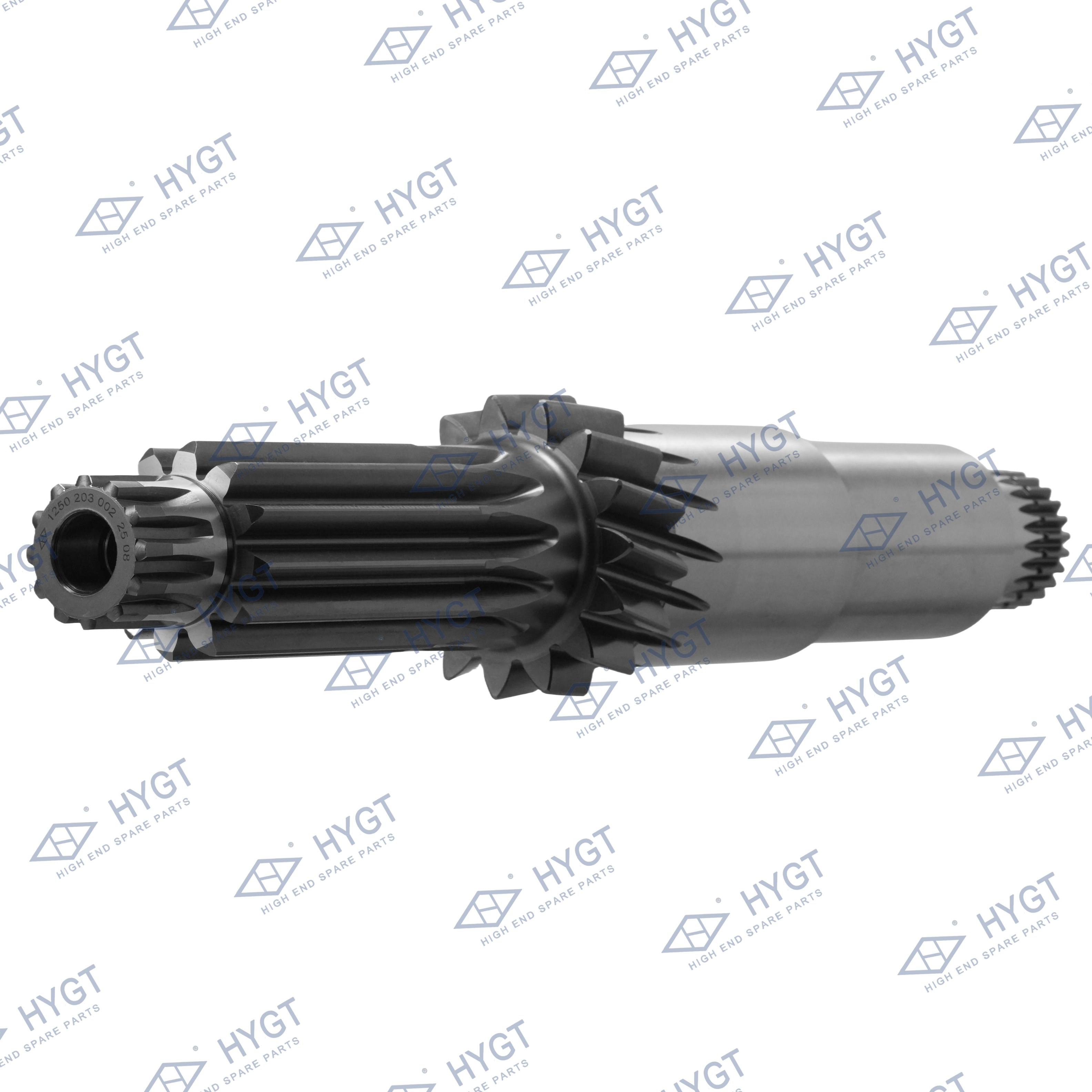
To accurately diagnose gear degradation, you first need to respect the brutal mechanical environment these components live in. In a heavy-duty commercial vehicle, the transmission handles relentless torsional stress. The countershaft—often called the layshaft on the shop floor—acts as the primary bridge in this power delivery ecosystem.
When a massive diesel engine generates rotational force, the clutch sends that raw power straight to the input shaft. However, in most gear ratios, this input shaft doesn't drive the output shaft directly. Instead, the input gear forcefully meshes with the driven gear on the countershaft. The countershaft then uses its series of precisely machined gears to drive mating gears on the main shaft. This is how the system achieves the exact torque multiplication the driver demands.
Looking at current industry trends, the rapid shift towards Automated Manual Transmissions (AMTs) and engine downspeeding has fundamentally rewritten the rules for commercial gearboxes. Today's advanced diesel engines deliver peak torque at much lower RPMs to maximize fuel efficiency. What does this mean for the hardware? It keeps the layshaft under sustained, extreme bending forces for much longer durations during a standard haul. This industry-wide evolution changes the game. Predictive maintenance isn't just a buzzword anymore; catching early signs of transmission gear wear is now the only reliable way to prevent a sudden on-road breakdown.
Because it sits lower in the transmission case, the countershaft is constantly churning through heavy gear oil. If dirt, silica, or metal flakes contaminate the fluid, the gear teeth on this specific shaft take the brunt of the abrasive assault. Veteran mechanics always inspect the layshaft first during a teardown. Its physical condition is the most accurate barometer for the internal health of the entire assembly.
Before you hastily toss a pricey transmission component into the scrap bin, you need to confidently tell the difference between benign surface changes and active destruction. Heavy-duty commercial gears are forged from high-alloy steel and undergo rigorous case-hardening, like carburizing. This complex metallurgical treatment creates a highly durable outer shell while keeping the inner core tough and ductile to absorb violent shock loads.
Fresh off the assembly line, a newly installed transmission enters a critical run-in period. Even with state-of-the-art precision machining, microscopic peaks and valleys cling to the gear flanks. As the truck logs its first few tens of thousands of miles, normal meshing action gradually flattens these imperfections. We call this "polishing." Normal wear presents strictly as a smooth, mirror-like finish right on the pitch line. The original engineered profile of the tooth remains completely intact, with zero measurable loss of material thickness. This simply means the gears have seated together perfectly under a healthy oil film.
In stark contrast, wear becomes destructive the exact moment active material loss alters the involute profile of the gear tooth. Once that protective case-hardened surface layer is breached, the softer inner core is violently exposed. At this critical juncture, degradation accelerates exponentially.
While a bright LED work light is mandatory, tactile feedback is often your best diagnostic tool. Drag a brass pick or your bare fingernail vertically across the working face of the gear tooth. If your pick catches on microscopic ridges, steps, or a rough, sandpaper-like texture, the hardened layer is actively failing. If the tooth profile feels wavy or the outer edge has developed a sharp burr that can slice a rag, the damage is irreversible.
Every mechanical failure leaves behind a distinct physical signature. By meticulously analyzing these patterns, you can trace the damage directly back to its root cause. This ensures you fix the underlying issue before bolting a fresh part in.
Pitting and Spalling (Surface Fatigue) starts as unseen, microscopic cracks deep below the gear face. As these cracks propagate to the surface under heavy loads, tiny chunks of metal break away, leaving shallow craters. If ignored, this turns into severe "spalling," where massive flakes of hardened metal peel off the tooth flank. This is a textbook sign of repeated, high-stress overloads. It usually means the truck has been routinely overloaded or the part has simply maxed out its metallurgical lifespan. Once spalling appears, the structural integrity of the ZF countershaft is fatally compromised.
Scoring and Galling (Adhesive Wear) tells a completely different story. Scoring looks like deep, aggressive vertical scratches running in the direction of the sliding action. Galling is the terminal stage of this condition. Localized friction generates so much intense heat that the metal from one gear briefly micro-welds to its mating partner. As the gears forcefully continue to turn, chunks of material are torn away, leaving a smeared, brutally scarred finish. Adhesive wear is almost strictly a catastrophic lubrication failure. The protective oil film completely broke down, likely due to low fluid levels, incorrect viscosity, or extreme operating temperatures.
Abrasive Wear doesn't stay localized; it attacks the entire contact surface. The teeth take on a dull, heavily scuffed appearance, as if hit with heavy-grit sandpaper. Over thousands of miles, the teeth physically thin out, becoming dangerously sharp at the tips. This pattern screams of massive contamination. The gear oil has turned into a destructive grinding paste, often caused by external dirt entering a clogged breather valve or internal metallic dust from a failing thrust bearing.
Uneven or Tapered Wear is usually obvious at first glance. The wear pattern isn't centered on the flank; it is heavily concentrated on one edge or at a severe angle. One end of the tooth might look pristine, while the opposite end is heavily pitted or chipped. Tapered wear is the industry's primary indicator of structural misalignment. It strongly suggests the taper roller bearings supporting the assembly have collapsed. When these crucial bearings lose preload, the shaft physically deflects under massive torque, forcing the gears to mesh at a destructive angle.
Trying to squeeze a few thousand extra miles out of a compromised transmission component is a massive gamble. Gear degradation is never static; it is a highly aggressive disease that rapidly infects the rest of the drivetrain ecosystem.
The earliest symptom of degrading gear teeth is a sharp spike in Noise, Vibration, and Harshness (NVH). Precision commercial gears are cut to exact profiles for a smooth, rolling transfer of immense power. When pitting or scoring alters this delicate profile, the gears stop rolling and start sliding and impacting. This improper meshing generates high-frequency vibrations that resonate loudly through the casing. In the cab, it sounds like a distinct whine, a deep howl under load, or a low-speed clunking during shifts. Ignoring this auditory alarm allows vibrations to travel down the driveline, accelerating wear on driveshaft U-joints and the rear differential.
Furthermore, a transmission is a tightly closed, interdependent system. If a gear on the layshaft develops severe spalling, it acts like a rotary milling machine against its mating gear on the main shaft. Running a flaking countershaft against a healthy main shaft will destroy the healthy component in a matter of hours. Those hardened steel flakes don't just vanish. They circulate through the fluid, embedding into soft brass synchronizer rings and deeply scoring delicate bearing races.
Making the call between reusing a seasoned part and ordering a brand-new replacement requires objective data. Guesswork has absolutely no place in heavy-duty transmission rebuilding. In the shop, eyeballing a part isn't enough. You need hard numbers from a dial indicator to measure shaft end-play and gear backlash. Excessive backlash means the teeth have thinned out significantly. You must also use precision micrometers to measure the bearing journals. If these journals are scored, blued from heat, or worn even a thousandth of an inch below spec, the shaft will fail to hold proper bearing preload.
A common question is whether a heavily damaged component can simply be welded or re-machined. For heavy-duty commercial gearboxes, the answer is no. The protective, wear-resistant outer layer is typically only a few millimeters deep. Grinding away deep pits completely removes this vital hardened layer, exposing the soft core beneath. When tolerances are exceeded, a full countershaft replacement is the only mechanically sound repair method.
To help engineers and fleet managers make the right call, refer to the following diagnostic and selection criteria based on real-world OE parameters:
Observed Wear Pattern | Damage Severity | Action & Recommended Component Specs |
|---|---|---|
Mirror-like polish strictly on pitch line | Normal (Run-in wear) | Reuse. Perform standard fluid flush and maintain maintenance intervals. |
Deep vertical scoring / Galling | Catastrophic (Lube failure) | Replace immediately. Requires high-alloy steel replacement with exact carburized case-hardening depth. |
Tapered wear / Angled contact patch | Severe (Misalignment) | Replace Shaft & Bearings. Spec matched to OEM (e.g., ZF 1250203002) for 12-15T load capacity to prevent future deflection. |
Sharp, knife-like gear tooth tips | Terminal (Abrasive thinning) | Replace Assembly. Involute profile is lost. Ensure replacement meets strict micro-geometry tolerances. |
Once your diagnostic teardown confirms a component has crossed the point of no return, procurement is your next hurdle. The heavy-duty commercial aftermarket is flooded with replacement parts of wildly varying quality. The internal transmission assembly is definitively not an area where you can compromise on metallurgical integrity to save a few bucks upfront.
A replacement shaft must match the original equipment manufacturer's exact specifications flawlessly. This includes the precise steel alloy composition, the exact depth of the case hardening, and the micro-geometry of the gear teeth. Even a microscopic deviation in the involute gear profile will result in severe transmission error, excessive cabin noise, and premature destruction of mating gears. High-quality manufacturing ensures the replacement part can effortlessly handle the immense low-end torque loads generated by modern diesel engines without bending or shearing.
Substandard aftermarket knock-offs might appeal to a tight maintenance budget, but they always introduce massive hidden costs. Low-quality components frequently suffer from inconsistent heat treatment. This makes them either far too brittle—prone to shattering under shock loads—or far too soft, leading to rapid galling. Inaccurate machining inevitably leads to poor fitment, forcing mechanics to waste valuable labor hours attempting to shim or force components into alignment. The staggering cost of a second, entirely preventable transmission teardown will always eclipse the initial perceived savings.
To ensure maximum vehicle uptime and protect your expensive transmission ecosystem, source precision-engineered components exclusively from dedicated drivetrain specialists. When a teardown reveals destructive pitting or tapered wear, installing verified heavy truck gearbox parts guarantees your vital equipment returns to optimal, factory-level performance.
Minor, localized polishing on the central contact areas of the gear teeth is entirely acceptable and simply represents normal run-in wear. However, any wear that physically catches a fingernail or brass pick, alters the original involute tooth profile, or shows visible signs of surface fatigue—such as pitting, flaking, or spalling—dictates mandatory and immediate replacement. Operating a heavy-duty transmission with compromised case hardening will rapidly lead to the complete degradation of the softer core metal beneath.
A persistent, high-pitched whining or howling noise that changes pitch with engine RPM is typically caused by advanced gear degradation. Specifically, it indicates improper, uneven meshing between the main shaft gears and the layshaft. This rough meshing is usually the direct result of altered gear tooth profiles due to severe abrasive wear, or a structural misalignment caused by failing taper bearings that allow the shaft to physically deflect under heavy torque loads.
The most common culprit is severe fluid contamination combined with excessive thermal stress. When metallic debris or external dirt infiltrates the gear oil, it acts as a lapping compound, rapidly wearing down the bearing rollers and races. Additionally, prolonged heavy hauling at low RPMs (engine downspeeding) puts immense radial loads on these bearings, accelerating wear if the lubrication film breaks down.
Backlash is measured using a magnetic-base dial indicator. You mount the base securely to the transmission casing and position the indicator tip perpendicularly against the pitch line of a gear tooth on the countershaft. While holding the mating main shaft gear completely stationary, you rock the countershaft gear back and forth gently. The total movement recorded on the dial indicator is your backlash, which must be compared against the manufacturer's specific tolerance manual.
In the vast majority of modern heavy-duty commercial gearboxes, the countershaft is manufactured as a single, solid forged piece of steel, or it utilizes individual gears that are heat-shrunk and pressed onto the main shaft with extreme hydraulic force. Because of this robust construction, attempting to safely remove and replace a single damaged gear in a standard shop environment is rarely viable or safe. Replacing the entire shaft assembly is the most cost-effective and mechanically sound solution to ensure proper rotational balance.
While you must always consult your specific manufacturer's service intervals, heavy-duty applications—such as regional logging, mining, or consistent maximum-weight freight towing—often require significantly accelerated maintenance schedules. In these severe-duty cycles, fluid changes are typically recommended every 50,000 to 100,000 miles. Frequent fluid changes are absolutely critical for flushing out microscopic metal shavings and thermally degraded oil, preventing the abrasive scoring that destroys hardened gear surfaces.
Don't gamble with your fleet's uptime. If your diagnostic teardown reveals severe wear, upgrading to precision-engineered components is the only way to restore factory-level performance. Visit HYGT to find the exact heavy-duty transmission parts your rebuild demands.


