
- All
- Product Name
- Product Keyword
- Product Model
- Product Summary
- Product Description
- Multi Field Search
Views: 0 Author: Site Editor Publish Time: 2026-09-18 Origin: Site


Few sounds make a fleet manager or driver wince quite like a harsh metallic crunch during a gear shift. This alarming transmission shifting problem usually points directly to worn internal components struggling to keep up with powertrain demands. In most teardown scenarios, the fault lies within the synchronizer assembly—specifically, either the synchronizer ring or the synchronizer hub is failing. Through this comprehensive engineering guide, we will break down how to accurately diagnose this exact issue. By understanding the mechanical distinctives of these parts, you can skip the guesswork and make a highly informed repair decision.
The Primary Culprit: The synchronizer ring acts as a sacrificial friction brake. It is by far the most common cause of an audible clash during shifts.
The Hub's Role: Serving as a robust structural anchor, the hub rarely fails first. However, it will suffer catastrophic secondary damage if worn rings are repeatedly ignored.
Diagnosis is Key: Grinding during one specific gear change isolates the issue to a worn ring. Conversely, a total inability to engage any gear often indicates severe hub or slider sleeve damage.
Quality Matters: Rebuilding a gearbox is incredibly labor-intensive. Utilizing premium replacement components ensures long-term mechanical reliability and prevents premature rework.
To fully grasp why a manual or automated transmission grinds, you must first understand the internal mechanisms designed to prevent that exact scenario. The most critical component in this high-speed fluid ballet is the synchronizer ring, frequently referred to as a blocker ring or baulk ring in the shop. You can visualize this precise component as a miniature, heavy-duty brake pad dedicated to an individual gearset.
When you actuate a shift, the target gear is spinning at a vastly different RPM than the transmission output shaft. If the heavy metal dog teeth of the gear and the sliding sleeve were forced together at mismatched speeds, the resulting impact would be violent. Specifically, the ZF synchronizer ring prevents this mechanical catastrophe. It utilizes targeted friction to perfectly equalize the rotational speeds before allowing the hard parts to lock together.
Since its core function relies entirely on generating massive friction, this ring absorbs immense thermal loads during every single shift cycle. To survive this brutal internal environment, engineers utilize highly specialized metallurgical composites. Historically, standard duty rings were machined from solid brass or bronze alloys, offering acceptable friction coefficients and rapid heat dissipation.
Furthermore, in modern high-torque commercial applications, standard brass simply cannot survive. Advanced heavy-duty designs now feature rigid forged steel bodies lined with specialized friction materials. For instance, premium rings utilize a Molybdenum (Mo) friction coating or carbon-composite linings. These advanced Mo-linings provide superior thermal stability and maintain a highly precise friction coefficient, ensuring the ring can aggressively grip the gear cone without glazing or disintegrating under extreme payloads.
The actual synchronization event happens in a fraction of a second. Yet, it involves a highly precise sequence of mechanical steps. Initially, as shift pressure is applied, the synchronizer sleeve pushes the ring against the tapered cone of the target gear. Following this initial contact, the internal Molybdenum or carbon friction lining bites into the spinning gear cone. It acts exactly like a brake—rapidly slowing down or speeding up the gear to match the main shaft RPM.
During this critical blocking phase, the asymmetrical teeth on the exterior of the ring physically block the sleeve from moving forward. Once the rotational speeds achieve perfect parity, the ring rotates slightly out of the way. This subtle movement allows the sleeve to slide smoothly over the gear's dog teeth, locking the drivetrain into place without a single jarring noise.
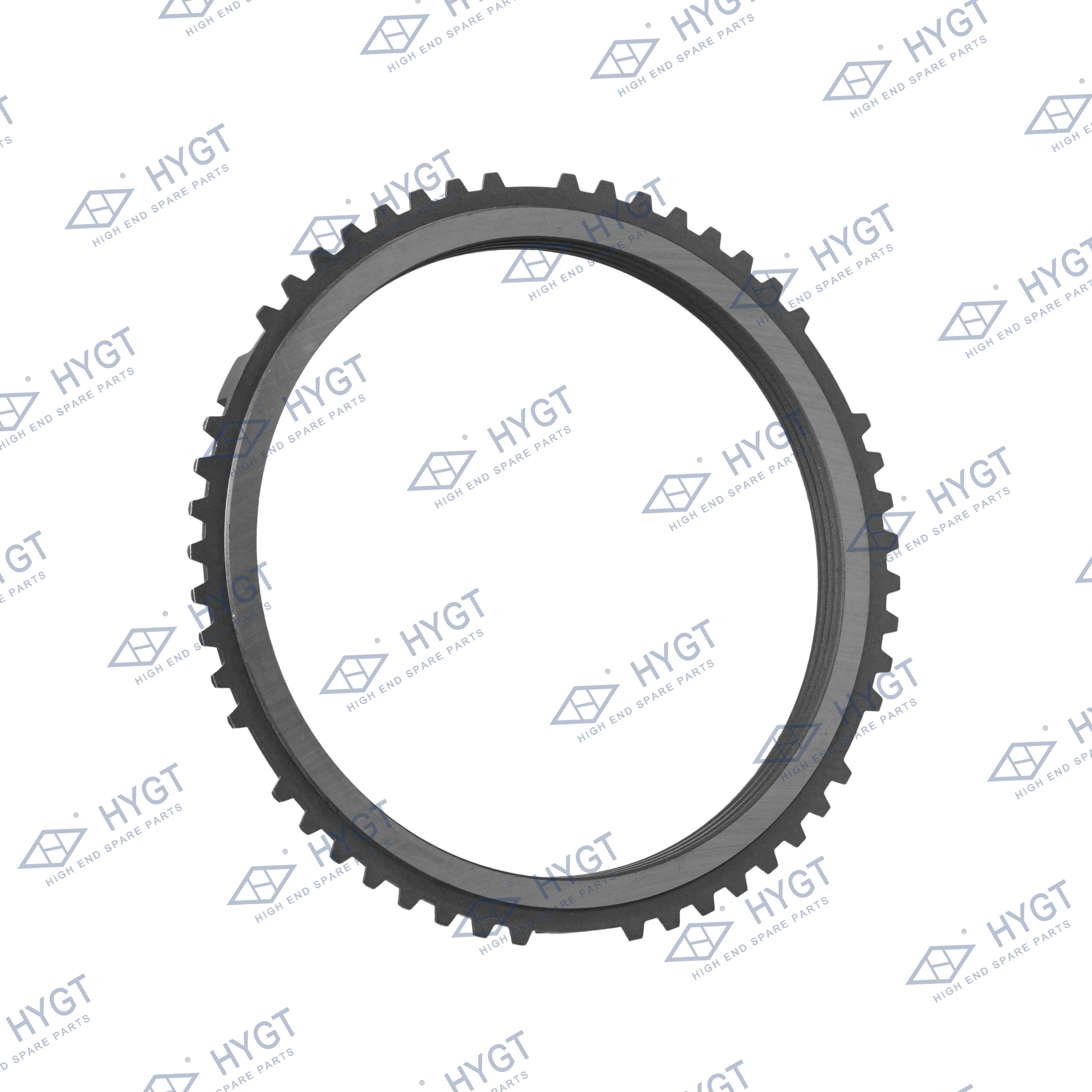
While the friction ring is the active braking element, it cannot function in a vacuum. It requires an absolute, unyielding foundation. That foundation is the synchronizer hub. This heavy-duty, central core anchors the entire synchronizer assembly to the powertrain.
The hub is permanently splined to the main transmission shaft. It features deep internal grooves that interlock flawlessly with the shaft's profile. Consequently, the hub is constantly rotating at the exact same speed as the vehicle's driven wheels. On its exterior perimeter, the hub features external splines where the synchronizer sleeve (or slider) rides back and forth.
In addition, the hub contains small, precisely machined slots that house struts and retaining springs. These keys press outward against the blocker ring, initiating the friction process the millisecond a shift is commanded. Essentially, the synchronizer hub acts as the critical structural bridge. It transfers massive engine torque from the engaged gear, through the sleeve, and straight down the main shaft to the pavement.
Unlike its friction-based counterpart, the hub does not rely on abrasive contact to perform its duties. It is a passive, structural powerhouse. Because it must handle the maximum torque output of the engine during heavy acceleration, it is forged from incredibly dense, hardened steel. Under normal operating conditions, this hub is engineered to last the entire lifespan of the transmission. It simply does not wear down from standard driving.
Looking at the broader commercial vehicle landscape, transmission synchronization is undergoing a massive metallurgical shift. With the rapid adoption of Automated Manual Transmissions (AMTs) in heavy-duty fleets, actuators are now executing shifts faster and with significantly more force than a human driver ever could.
Consequently, traditional brass rings are rapidly becoming obsolete in high-torque environments. Industry data shows a definitive pivot toward multi-cone synchronizer assemblies utilizing advanced carbon-composite or Molybdenum (Mo) linings. These specialized friction materials handle the aggressive thermal cycling of modern AMTs without degrading. This engineering shift ensures maximum uptime for commercial fleets, proving that lightweighting initiatives must never compromise the sheer durability required by the hub and ring ecosystem.
To accurately diagnose a drivetrain issue without wasting shop hours, mechanics must understand the distinct operational differences between these two components. While they live together in the same metallic housing, their functions, material compositions, and failure rates contrast sharply.
Feature | Synchronizer Ring | Synchronizer Hub |
|---|---|---|
Primary Function | Active friction brake to match gear speeds. | Passive structural anchor transferring torque. |
Material Construction | Forged steel with Molybdenum (Mo) or carbon lining. | High-density hardened forged steel. |
Wear Susceptibility | High. Designed as a sacrificial wear item. | Low. Rarely fails unless secondary damage occurs. |
Failure Symptom | Harsh grinding noise during specific gear shifts. | Transmission stuck in gear or popping out under load. |
When evaluating a manual or AMT gearbox failure on the bench, shop data is highly consistent. In the vast majority of cases, the friction ring is the direct and primary cause of an audible clash.
Fundamentally, this ring is a wear item. Every time a gear is engaged, a microscopic layer of friction material is shaved away. Over hundreds of thousands of miles, the internal Mo-lining or threading eventually becomes completely smooth. When this critical friction loss occurs, you will experience a harsh crunching sound. This gearbox grinding noise usually isolates itself to one specific upshift or downshift, such as moving into third gear.
You might also feel noticeable physical resistance through the linkage. The stick shift feels like it is hitting a rubbery wall before finally popping into the gate. The terrible noise you hear is not the ring itself; it is the heavy metal dog teeth of the gear violently crashing into the sleeve because the rotational speeds were not properly synchronized.
If the ring is the primary culprit, when does the hub actually fail? Typically, it only suffers damage as a secondary consequence of severe operator neglect. If a vehicle is repeatedly forced into gear despite horrible grinding noises for months on end, the violent mechanical impacts will eventually send shockwaves through the sleeve and directly into the hub's splines.
Symptoms of a compromised hub include the transmission becoming physically jammed in gear, severe mechanical shuddering, or the stick violently popping out of gear under heavy engine braking. In extreme abuse cases, the internal splines connecting the hub to the main shaft can shear off completely.
While we have narrowed down the primary suspects, a comprehensive mechanical diagnosis must consider the entire drivetrain ecosystem. Sometimes, a shifting issue can perfectly mimic a bad friction ring but actually stem from peripheral components.
The sleeve slides directly over the hub to lock the gear. The inside of this collar features pointed internal splines. Due to aggressive shifting or a previously failed ring, the points on these splines can become blunted or rounded off. When this occurs, the sleeve cannot maintain its mechanical grip, causing the transmission to unexpectedly pop into neutral when you step on the throttle.
The shift fork is the metal prong that physically actuates the sleeve. If a driver habitually rests their heavy hand on the shift knob while cruising, it places constant, uneven pressure on the fork, causing it to warp. A bent fork will not push the assembly far enough to fully engage the gear, resulting in a grind. Similarly, worn pilot bearings can allow the internal shafts to deflect and wobble, preventing the rings from making flush, even contact with the gear cones.
Heavy-duty gearboxes rely on specific synthetic oils formulated with highly precise friction modifiers. If the fluid is too low, contaminated with metallic shavings, or simply broken down from thermal degradation, it alters the internal friction coefficient. If the oil is too slippery, the Mo-lining cannot grip the cone. If it is too thick, it will not squeeze out from between the mating surfaces fast enough. Both scenarios lead to immediate clashing, even if the hard parts are perfectly healthy.
Accurately identifying the root cause prevents mechanics from throwing expensive parts at a guess. A professional diagnosis should always follow a logical, step-by-step engineering framework.
A dynamic road test is the most effective way to isolate the issue before dropping the transmission. Pay close attention to whether the noise happens in every single gear, or only when shifting into a specific gear. If it grinds universally across all gears, the issue is likely a dragging clutch that fails to disconnect engine power, or severely degraded fluid. Conversely, if it only grinds in third gear, the issue is isolated strictly to the third gear synchronizer assembly.
You can also utilize the double-clutching technique. If releasing the clutch in neutral and rev-matching perfectly eliminates the crunch, it mathematically proves the ring has lost its friction material and can no longer synchronize speeds on its own.
Once the gearbox is dropped from the chassis and split open on the workbench, a visual inspection confirms the diagnosis. Look closely at the inner friction surface of the ring. If the distinct threading or Molybdenum coating is worn completely flat—revealing shiny bare steel—it belongs in the scrap bin.
Next, check the hub for hairline cracks radiating from the keyway slots and inspect the external splines for burrs. Finally, examine the dog teeth on the gear itself. If the engagement points are smashed or rounded, replacing the ring alone will not cure the ailment; the gear must be replaced as well.
Once the casing is open, you face a critical decision regarding replacement components. Commercial rebuilds are highly labor-intensive. The cost of the physical hardware is often dwarfed by the shop hours required to press off bearings, heat-shrink gears, and reassemble the unit.
If you confirm that only one ring is worn smooth, you might be tempted to swap just that single piece to save a few dollars. However, standard engineering practice dictates replacing the entire mated assembly—including the ring, hub, sleeve, and retaining springs. Because a worn ring allows the sleeve and gear teeth to violently clash, there is almost always microscopic stress damage to the surrounding metal.
Furthermore, the internal environment of a gearbox operates on extreme tolerances. The aftermarket is flooded with cheap alternatives that utilize incorrect cone angles and inferior linings. If the taper angle is off by even a fraction of a degree, or if the friction coefficient does not match factory specs, the new ring will not grip properly. To ensure a permanent, reliable repair, it is imperative to source authentic ZF gearbox parts. Investing in premium components with proper Molybdenum coatings guarantees perfect spline engagement and restores the buttery-smooth shifting your vehicle was designed to deliver.
While you technically can keep a vehicle moving by utilizing advanced driving techniques like double-clutching or precise rev-matching, doing so on a daily basis is highly risky. Continuing to drive with a grinding gearbox will eventually destroy the gear's dog teeth, the sleeve, and the hub. What starts as a relatively straightforward maintenance item can rapidly escalate into a catastrophic mechanical failure requiring a massively expensive total rebuild.
The physical component itself is relatively inexpensive. However, the total cost of the repair is usually quite high due to the extensive labor involved. To replace it, a technician must completely remove the transmission from the vehicle, tear down the casing, and press the heavy gearsets off the main shaft. This labor-intensive teardown constitutes the vast majority of your final repair bill.
Each forward gear in your transmission utilizes its own dedicated friction ring. In typical city driving, vocational routes, or heavy stop-and-go traffic, second and third are the most frequently engaged gears. Because they experience significantly more shift cycles and thermal loads than highway cruising gears, their friction material naturally wears out much faster, leading to isolated clashing issues.
It entirely depends on the root cause of the symptom. If the issue is caused by old, degraded, or incorrect fluid that lacks the necessary friction modifiers, a comprehensive fluid flush might restore smooth operation. However, if the physical friction material (like the Mo-coating) on the internal ring is mechanically worn away down to the bare metal, no amount of fresh, high-quality oil will magically restore that lost material. In cases of physical wear, a complete teardown and replacement is the only viable solution.
Under normal operating conditions with proper fluid maintenance, a high-quality synchronizer ring can easily last 300,000 to 500,000 miles in a commercial vehicle. However, lifespan is heavily dependent on driving habits. Aggressive shifting, resting a hand on the shifter, or skipping routine fluid changes can destroy a ring in a fraction of that time.
Yes. While the hub is incredibly durable, if its splines become severely damaged from repeated gear clashing, it can fail catastrophically. A shattered hub can send hardened steel shrapnel throughout the gearbox, destroying bearings, gears, and even punching a hole straight through the aluminum transmission casing.
Ready to fix your transmission the right way? If you have diagnosed a failing synchronizer assembly and need to source reliable, heavy-duty replacement components, choosing the right manufacturer is critical. Explore our full catalog of premium drivetrain solutions at https://www.hygt-spa.com to find the exact OEM-grade match for your rebuild, ensuring your fleet stays on the road and out of the shop.


